Skip to content


There are four main types of commercial gate access control systems: keypads, telephone entry systems, RFID readers, and license plate recognition (LPR). Keypads are the simplest and most affordable. Telephone entry systems are best for letting visitors in. RFID readers give residents and employees fast, hands-free entry. LPR cameras offer the most seamless vehicle access but cost the most. Most commercial properties combine two of these, usually RFID or LPR for regular users plus a telephone entry system for visitors.
Here’s how each one works, what it costs, and which gate entry system fits your property.
Quick Comparison
|
|
Keypad |
Telephone Entry / Video Intercom |
RFID |
LPR |
|
How it works |
User enters a PIN code |
Visitor calls a resident or office, who opens the gate remotely |
Card, fob, tag, or remote is read automatically |
Camera reads the license plate and checks it against an approved list |
|
Best for |
Small sites, deliveries, staff |
Visitors and guests |
Residents, employees, tenants |
High-traffic vehicle gates |
|
Hands-free |
No |
No |
Yes (with long-range tags) |
Yes |
|
Visitor handling |
Shared or temporary codes |
Excellent |
Poor (credential required) |
Poor (plate must be enrolled) |
|
Security level |
Low to moderate (codes get shared) |
Moderate to high (video adds verification) |
High |
High |
|
Audit trail |
Basic |
Yes, often with video |
Yes |
Yes, with plate images |
|
Relative cost |
$ |
|
$$$ |
|

What Is a Commercial Gate Access Control System?
A commercial gate access control system decides who can open a vehicle or pedestrian gate, and when. Whichever access method you choose, every gate entry system includes the same basic parts:
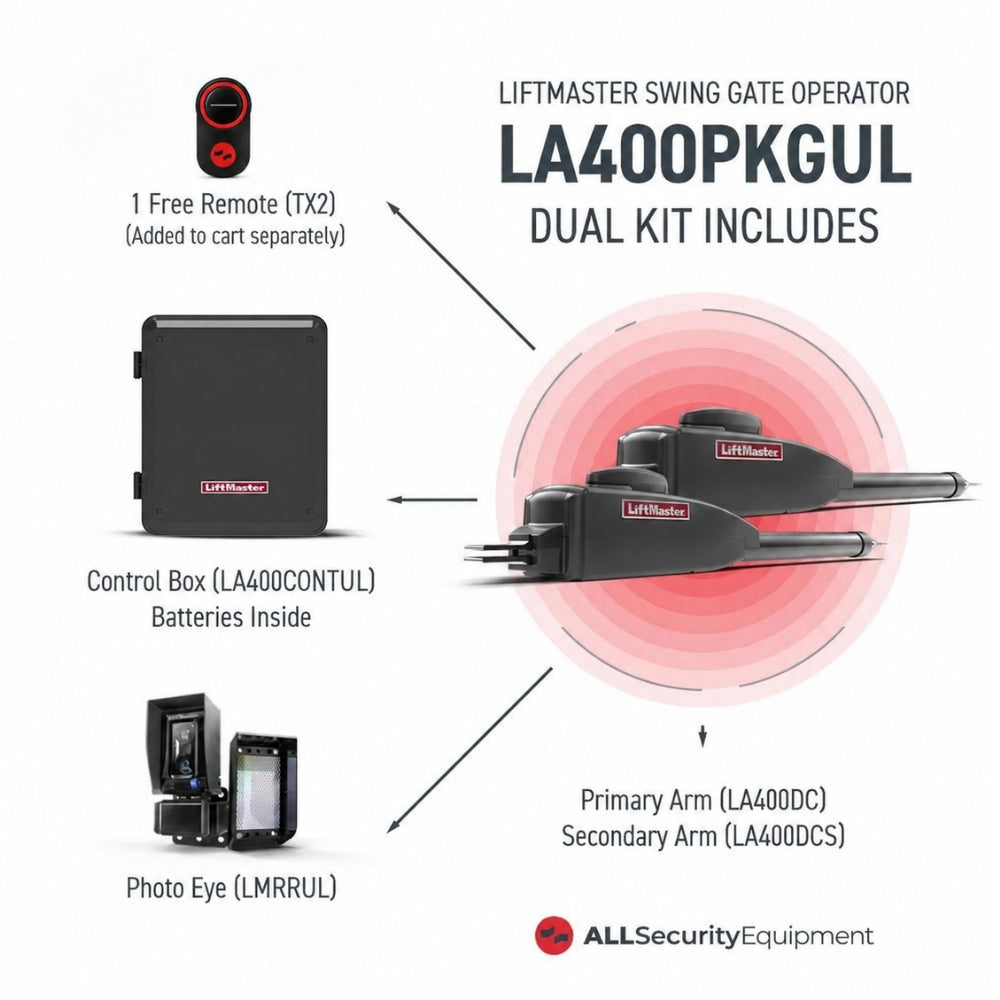
• Gate operator: the motor that opens and closes the gate. Shop Gate Openers and Operators or Parking Barrier Gates.
• Access device: the keypad, telephone entry system, reader, or camera that verifies the user.
• Controller: stores authorized users and sends the open command to the gate operator. In many systems it’s built into the access device.
• Free exit and safety devices: vehicle loop detectors, photo eyes, and edge sensors that let vehicles exit and keep the gate from closing on people or cars.
• Credentials: PIN codes, cards, fobs, remotes, or registered license plates.

4 Types of Gate Access Control Explained
1. Keypad Gate Entry Systems
A keypad mounted on a gooseneck pedestal or post lets users type a PIN code to open the gate. Many models store hundreds or thousands of codes and can assign time limits to each one.
• Pros: low cost, simple to install, no credentials to buy or replace
• Cons: codes get shared and written down, drivers have to stop and reach out, limited visitor management
• Best for: small business lots, equipment yards, delivery entrances, and backup entry at larger gates
2. Telephone Entry Systems for Gates
Telephone entry systems let visitors look up a resident or tenant in a directory and call them. The person answering can then open the gate remotely by pressing a number on their phone. Modern versions add video, smartphone apps, and cloud management, and many also include a built-in keypad or card reader for residents.
• Pros: the best way to handle visitors and deliveries, verifies who is at the gate, and video models record every entry
• Cons: higher upfront cost, slower for daily users, and some systems need a phone line, cellular plan, or subscription
• Best for: apartment communities, HOAs, gated offices, and any property with frequent visitors
Systems like the LiftMaster Smart Video Intercom bring telephone entry, video, and cloud management together through myQ Community. Browse our Intercom and Telephone Entry Systems, including wired and wireless options.
3. RFID Gate Access Control
RFID readers identify a credential automatically. Standard proximity readers read cards and fobs held a few inches away. Long-range readers can read windshield tags or hang tags from several feet away, so drivers never roll down the window. Gate remotes work in a similar way, using radio signals sent to a receiver at the gate.
• Pros: fast, convenient, and secure; lost credentials can be shut off instantly; full audit trails
• Cons: every user needs a credential, and you need a separate solution for visitors
• Best for: residents, employees, tenants, fleet vehicles, and self-storage customers
Learn more in our long-range RFID reader guide, and shop Fob and Card Readers and HID credentials.
4. License Plate Recognition (LPR)
LPR uses a camera to capture a vehicle’s license plate, read it with software, and compare it to a list of approved plates. If there’s a match, the system opens the gate automatically.
• Pros: completely hands-free, no credentials to issue, and every entry is logged with a photo
• Cons: highest cost, and accuracy can drop with poor lighting, bad camera angles, dirty or obstructed plates, and fast-moving vehicles
• Best for: high-traffic parking facilities, corporate campuses, logistics yards, and premium residential communities
Read our guide to license plate recognition cameras to learn more.
Which Gate Access Control System Is Best for Your Property?
The best vehicle gate access control system depends on who comes through your gate every day:
• Apartment communities and HOAs: RFID or LPR for residents, plus a telephone entry system or video intercom for guests and deliveries.
• Self-storage facilities: keypads tied to tenant accounts are standard, often with time-based access. See the best access control systems for self-storage facilities.
• Offices and industrial sites: RFID cards or tags for employees, plus a telephone entry system at the visitor lane.
• Parking lots and garages: parking lot entry and exit control systems usually combine barrier gates with RFID, LPR, or ticketing. Explore our Parking Systems.
• Small businesses and equipment yards: a standalone keypad is often all you need.
Can You Combine Gate Entry Methods?
Yes, and most commercial properties do. Layering access methods lets you match each type of user to the fastest, most secure option. A common setup is:
1. Residents or employees: RFID tags, remotes, or LPR for hands-free daily entry
2. Visitors: a telephone entry system or video intercom at the gate
3. Deliveries and service providers: temporary or time-limited keypad codes
4. Exit: a vehicle loop detector for free exit
Many telephone entry systems include a built-in keypad and card reader, so one device at the gate can handle all three user types.
Tips for Choosing Commercial Gate Access Control
• Count your daily traffic. High-traffic gates need hands-free options like long-range RFID or LPR to avoid backups.
• Plan for visitors. If guests come through the gate, you’ll need a telephone entry system or video intercom.
• Check power and connectivity. Confirm whether the system needs a phone line, cellular service, or internet at the gate.
• Make sure everything is compatible. Your access device must connect to your gate operator. Check the operator’s accessory inputs before buying.
• Don’t skip safety. Use photo eyes, edge sensors, and loop detectors so your gate operates safely and meets UL 325 requirements.
• Think about management. Cloud-based systems let property managers add or remove users in real time from anywhere.
FAQs
What are parking access control systems?
Parking access control systems manage which vehicles can enter and exit a parking area. They usually combine a barrier gate or slide gate with an access method such as RFID, LPR, keypads, or ticketing. Read our parking lot gate system guide for more.
What is the most secure gate access control system?
RFID and LPR are the most secure for regular users because each entry is tied to a specific credential or vehicle. Adding a video intercom for visitors makes the whole system more secure.
Do telephone entry systems need a phone line?
Not always. Traditional telephone entry systems use a landline, but many newer models connect through cellular service or the internet and let residents answer from a smartphone app.
Can I use gate remotes for commercial access control?
Yes. Remotes are convenient for small user groups, but they’re harder to track and revoke than RFID credentials. For larger properties, choose a system with individually managed users. Shop Remotes and Receivers.
Build the Right Gate Access System for Your Property
Choosing between keypad, telephone entry, RFID, and LPR doesn’t have to be complicated. All Security Equipment carries gate operators, barrier gates, telephone entry systems, readers, credentials, and accessories, so you can build a complete commercial gate access control system from one supplier. Gate and fence installers can ask about trade pricing for qualifying accounts.